
Introduction: A common misunderstood phenomenon
“Why are my pajamas pilling after a few washes? Is there something wrong?”
This is the customer enquiry that the Wingtu Lounge factory receives every month. In fact, Pilling is not the same as inferior quality, it is the result of the combination of fiber physical properties and use-from affordable polyester to high-end cashmere, almost all textile fabrics will appear Pilling to varying degrees.
For small and medium-sized B-end customers (e-commerce brands, independent site sellers, offline buyers), it is very important to understand the real cause of pilling: it can not only help you explain product characteristics to end consumers, but also help you in product selection. In the customization stage, cooperate with the factory to start the pilling probability from the root.
This article will systematically answer the problem of pajama pilling from the three dimensions of fiber science, fabric technology, and washing misunderstandings, and compare the actual performance of Modal and cotton.

What is fabric pilling
Pilling refers to the phenomenon that the loose fiber heads on the surface of the fabric gradually slide out of the yarn, break, and wrap with each other to form small hair balls (Pills) under the action. These hairballs attach to the surface of the fabric, making the clothes rough to the touch and old to the appearance.
Key cognition: Pilling is a mechanical process of “fiber breaking and entanglement”, not fabric decay. Therefore, it can be greatly delayed by correct fiber selection, weaving process and finishing means.
Five Core Causes of Pajama Pilling
1. Fiber length and material
The longer the fiber, the less the end, the less easy it is to pill; The shorter the fiber, the more ends, the easier it is to loosen in the middle.
| Fiber Type | Pilling Tendency | Why |
|---|---|---|
| Short-staple cotton (standard, low-grade) | High | Lots of exposed fiber ends that break and tangle easily |
| Long-staple / combed cotton (Pima, Egyptian) | Low | Longer fibers, fewer ends; combing removes short fibers |
| Modal | Low | Long regenerated cellulose filaments, smooth surface |
| Tencel / Lyocell | Very Low | High tenacity, ultra-smooth surface, low fuzz retention |
| Synthetic staples (polyester, acrylic) | High | Strong and elastic—broken fibers don’t shed, they accumulate |
| Blends (cotton-poly) | Very High | Cotton breaks first, polyester traps the broken fibers into stubborn pills |
Wingtu Lounge will usually advise customers with high pilling requirements to give preference to long-staple cotton, combed cotton, high-gram Modal or Tencel. If the cost is limited and blending must be used, it is necessary to remove the excess hairiness on the surface in advance through singeing, biological enzyme polishing and other finishing processes.
2. Fabric construction: knit vs woven
Fabric structure: Knitted vs woven pajamas For close-fitting comfort, most of them use knitted structures (such as sweat cloth, double-sided cloth, ribbed). Knitting is made of coils strung together, and the fiber has a large space for activity, so it is easier to produce hairiness and entangle into balls.
In contrast, woven fabrics are tightly interwoven, have low fiber mobility, and have a much smaller probability of pilling, but at the expense of elasticity and closeness.
Conclusion: The comfort needs of pajamas determine that they are almost necessarily knitted fabrics, so the risk of pilling is higher than that of shirts or coats at the category level. It’s not a flaw, it’s a trade-off of physical structure.
3. Friction
Studies show that the average person rolls over about 20-30 times a night. Calculated by 7 days a week, there are more than 200 cycles between pajamas and bedding. In addition:
- Wearing pajamas for a long time during the day to work from home, doubling the duration;
- Exteriors such as backpack straps, rough surfaces on sofas, seat belts, etc. will significantly accelerate local pilling.
4. Washing
Wrong washing is an artificially controllable factor that causes pajamas to pill early, and it is also the easiest link for consumers to improve:
| What You’re Doing Wrong | What It’s Actually Doing |
|---|---|
| Washing with jeans, towels, or zippered items | Rough fabrics act like sandpaper inside the drum |
| Heavy-duty / high-speed spin (>800 RPM) | Mechanical stress breaks fibers at a much higher rate |
| Hot water (>113°F / 45°C) | Swells and weakens fiber bonds |
| High-heat tumble drying | Heat embrittles fibers; tumbling adds more friction |
| Harsh or powdered detergents | Strip surface protection and leave abrasive residue |
| Overloading the machine | Clothes grind against each other with no room to move |
5. Spinning and finishing process
At the Wingtu Lounge factory end, the same batch of cotton fibers is spun by Compact Spinning vs ordinary ring spinning, and the yarn hairiness can be 30-50%. In addition:
- Combed process (Combed): remove short fibers before spinning, and only retain long fibers;
- Singeing: Using a flame to quickly skim across the cloth to burn off prominent hairiness;
- Bio-polishing: Use cellulase to gently etch the loose fibers on the surface, hardly affecting the strength of the fabric.
For B-end customers: If you are looking for a pajama supplier, asking the other party whether they have combing, compact spinning or biological enzyme washing capabilities is an effective way to judge the professionalism of their quality control.
Modal pilling vs cotton pilling: Deep contrast
Modal and cotton are two of the most commonly used natural-based fibers for pajamas, but they have very different pilling logics.
Modal
- Advantages: The fiber is slender and uniform, the surface is smooth, and the coefficient is low. With standard wear and proper washing, Modal pajamas pill significantly slower than regular cotton.
- Weakness: High temperature and strong chemical agents. Water temperature exceeding 30 °C, chlorine-containing bleach, and high-temperature drying may all cause fiber surface structure and induce hairiness.
- Suggestions for purchasing: give priority to Modal fabrics with high weight (≥ 180 g) and high density knitting, and confirm whether the factory has done anti-pilling pre-shrinkage treatment.
Cotton
- Advantages: After pure cotton pills, due to the low strength and lack of elasticity of the cotton fiber itself, the hair balls will often fall off naturally in the subsequent washing, and will not adhere stubbornly like polyester.
- Weakness: short-staple cotton (fiber length < < 3cm) or low-count woolen cotton, quick pilling and dense hair balls. Combed cotton and long-staple cotton (e.g. Pima, e.g. cotton) can significantly improve this problem.
- Suggestions for purchasing: Check the fabric specifications, “(Combed)” and “(Long-staple)” are key labels for anti-pilling.
Summary:
Pursue extreme smoothness and low pilling → choose high-grade Modal or Tencel;
Pursue breathable and skin-friendly and accept slight hairiness → choose combed long-staple cotton;
Avoid cheap cotton-polyester blends and staple acrylic fibers, which are hardest hit by pilling problems.

How can I prevent pajamas from pilling?
Care Guide for End Consumers
- Turn-over wash: Turn the inside of the pajamas outward, and the outer surface is direct.
- Putting into laundry bag: Use fine mesh laundry bag to isolate, mechanical damage in the drum.
- Same kind of washing: only mixed with soft clothes, away from denim, towels, and zippers.
- Cold water is gentle: water temperature ≤ 30 °C, select the “Gentle/Fine Clothing” program, speed ≤ 600 rpm.
- Lay flat and dry in the shade: avoid exposure to the sun and drying at high temperature. When Modal and cotton are exposed to direct sunlight for more than 4 hours, the fiber strength will decrease significantly.
- Rotate wear: Do not wear a set of pajamas for multiple days in a row to give the fibers time to recover.
Purchasing suggestions for B-end brands/buyers
If you are a small and medium-sized B-end customer who is selecting products or looking for a factory, the following suggestions can help you complain from the source:
- Clarify the fiber specifications: Don’t just ask “Is it pure cotton”, but ask “What is the average length of cotton fibers? Has it been combed?“
- Pay attention to weaving parameters: the higher the gram weight (GSM), the finer the yarn count, the denser the needle number, and the more stable the structure. The recommended knitted weight of pajamas is not less than 160-180 gsm.
- Required finishing process: Specify in the contract whether singeing, pre-shrink (Pre-shrunk) or biological enzyme washing is required. The cost of these processes is not high, but they can significantly improve the terminal experience.
- Request for test report: Supplier is required to provide Martindale Test or ICI pilling box test results, pilling resistance level 3-4 or above is qualified.
- Small batch test: For new fabrics, first place a small order for wearing/washing test, verify the performance after 3-5 washes, and then decide whether to put into mass production.

It’s already pilling, can it be saved?
Yes. Pilling is a surface phenomenon that usually does not damage the fabric itself. Safe deball method:
- Electric hair ball trimmer (recommended): Choose the model with knife net protection, gently stick to the surface and slide. Clothes ball comb: suitable for local small area, manual control strength.
- Fresh razor blades (emergency): Lay the clothes flat and scratch lightly in one direction, avoid scratching back and forth.
- Absolutely forbidden: Hard-pulling furballs with your hands. This pulls more fibers out of the yarn, creating a vicious circle of “pulling and pilling”.
Conclusion
Pilling of pajamas is not a unilateral “problem”, but the result of the joint action of fiber characteristics, weaving technology, and usage habits. As an end consumer, you can extend the life of your pajamas through scientific washing; As a brand owner or purchaser, you can minimize the risk of pilling before the product hits the shelves by choosing the right fiber specifications and factory processes.
In the daily production of Wingtu Lounge, anti-pilling has never been an isolated indicator-it is related to the complete chain of fiber procurement, spinning, knitting density, finishing process and even garment care instructions. For small and medium-sized brands that want to build word-of-mouth, aligning these technical standards with factories upstream is far more valuable than after-sales explanations.
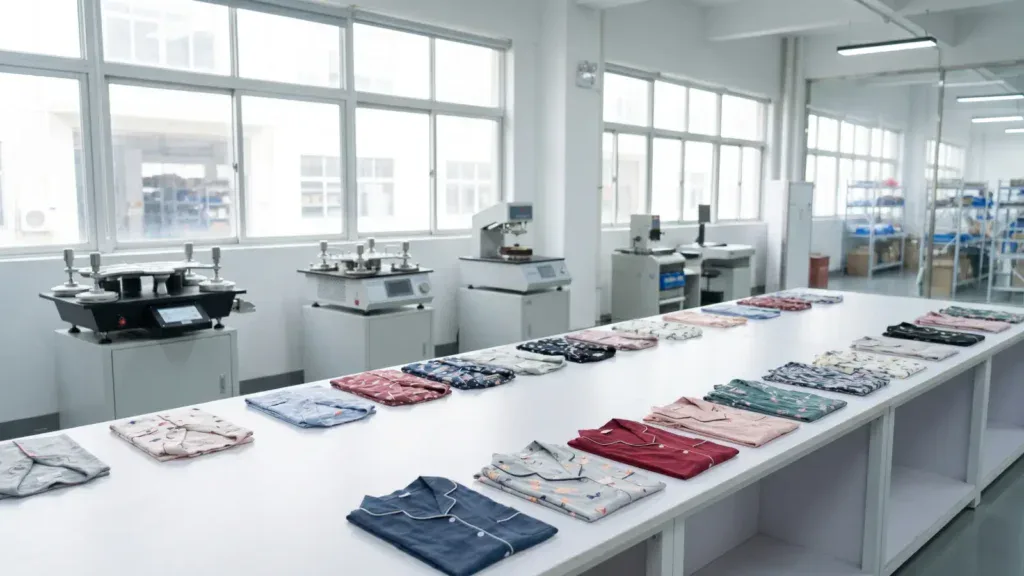
About Wingtu Lounge
Wingtu Lounge is a Chinese apparel factory focusing on pajamas and home clothing OEM/ODM, providing small-batch flexible supply chain services for small and medium-sized e-commerce brands, independent site sellers and offline buyers. If you want to solve quality control problems such as fabric pilling, shrinkage, and color fastness from the root during the product selection stage, please contact Wingtu Lounge through the on-site inquiry to obtain fabric solutions and proofing support.